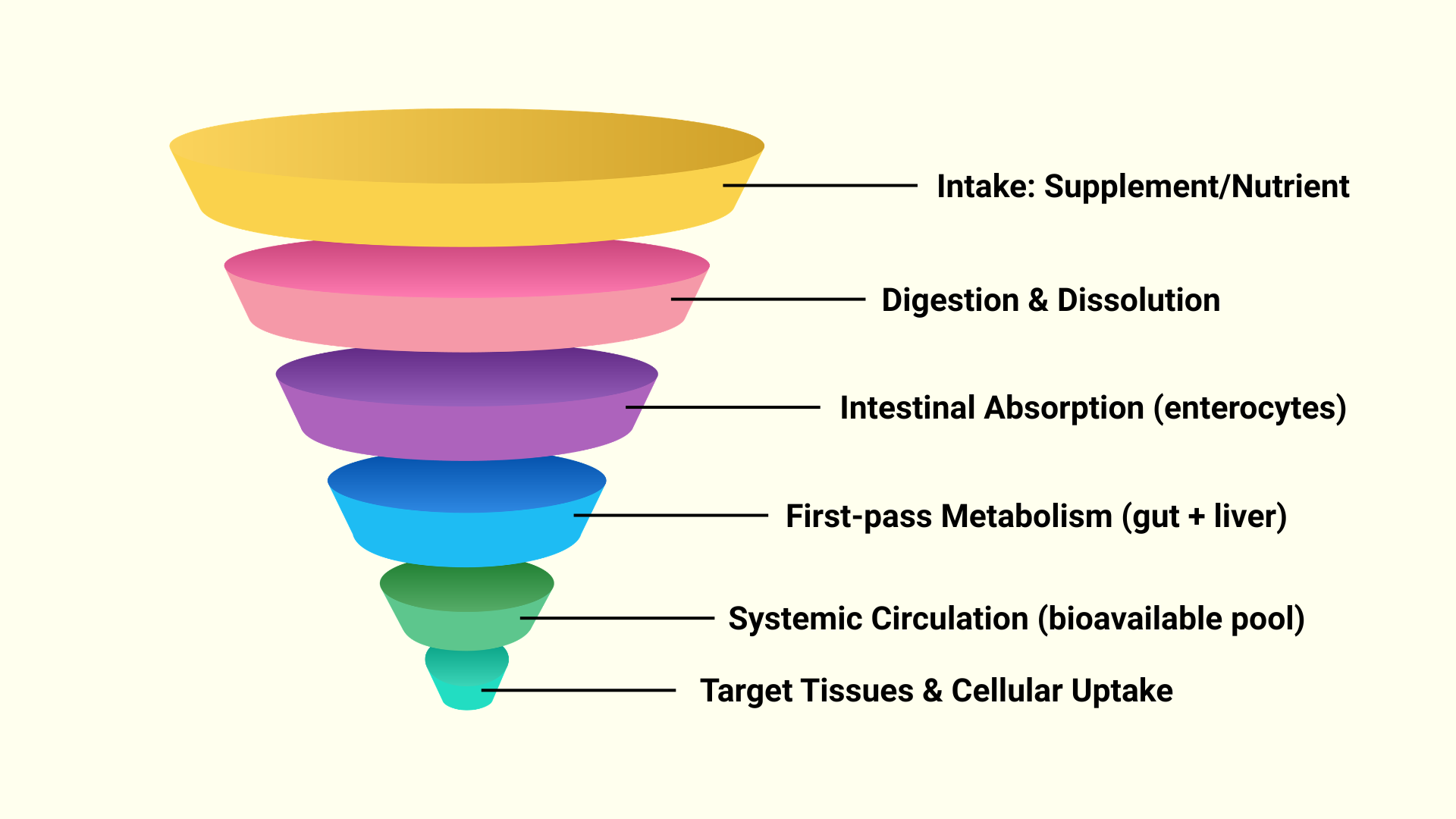
We often assume that taking a supplement or therapy guarantees health benefits. In reality, the body’s ability to absorb and use what we take can be the crucial bottleneck. Modern science shows that bioavailability – the fraction or amount of a nutrient or drug that actually reaches systemic circulation – depends on multiple barriers (intestinal uptake, gut metabolism, liver “first-pass” effect, cellular delivery). This article explores how absorption works (and fails) with context, scientific explanations, and practical tips. It uses expert insights, peer-reviewed sources, and real-world examples to explain why identical intakes often yield different results, and how new delivery technologies (lipid carriers, liposomes, prodrugs, adjuvants) can improve uptake. We include a flowchart of the absorption pathway, a comparison table of advanced delivery methods, a human anecdote, and actionable takeaways to help you (or your patients) optimize nutrient use.
“Many people take supplements expecting quick results, but the real issue is often absorption, not intake.” – a reminder that the gut is a gatekeeper. [1]
From routine to frustration: a common scenario
Imagine Sarah, a fitness enthusiast, carefully adding the latest high-potency vitamin supplement to her morning routine. She expects a boost in energy and clearer skin. Weeks pass and… nothing. Meanwhile, her friend Rahul takes the same brand and seems to feel fine. What happened? Sarah took good quality products, but her body didn’t see the promised results.
This scenario happens daily. People pile products on their cabinets, yet often ask: “Why isn’t this working?” The answer may lie not in the pills themselves, but in the invisible journey from pill to cell. As Dr. Sharad Malhotra explains, “For any nutrient to work, it must be properly absorbed in the gut, which depends on factors like digestive health, gut lining integrity, enzyme activity, and even the presence of other nutrients.”[1] Put simply, the gut acts as a gatekeeper. If nutrients fail to cross that gate, even the best supplement goes to waste.
This tension – intake vs. actual uptake – reframes how we think about health support. It suggests that swallowing something beneficial is only half the battle; the other half is biological access. The rest of this article unpacks that journey.
Biological barriers to “magic pill” effects
In pharmacology and nutrition, the journey of an ingested compound is often described by pharmacokinetics (ADME: Absorption, Distribution, Metabolism, Excretion). Here we focus on absorption and bioavailability. Absorption is defined as “the transportation of the unmetabolized drug (or nutrient) from the administration site to the body circulation”[2]. In other words, how much of what you swallow actually makes it into the bloodstream intact.
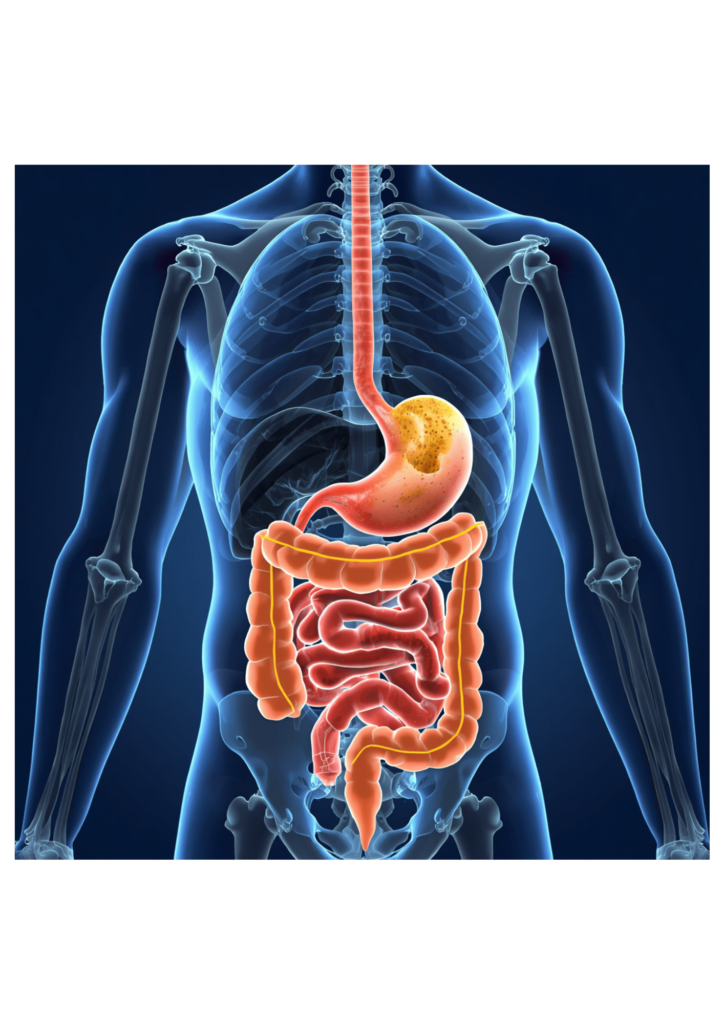
The small intestine is the primary absorption hub: it breaks down food, absorbs needed nutrients, and blocks unwanted components[3]. Its lining is specially designed for this task: millions of microvilli (tiny projections) on enterocyte cells create maximal surface area[4]. Yet this lining is also a selective barrier. Nutrients must pass through cell membranes (by diffusion or transporters), surviving digestive enzymes and acids along the way.
Crucially, not everything crosses easily. Many substances undergo extensive first-pass metabolism in the gut wall or liver before reaching systemic circulation[5]. The StatPearls review notes:
“Before orally administered drugs reach the circulation, they can be metabolized within the gut wall or the liver. This is known as first-pass metabolism, which will decrease the amount of active drug absorbed.”[5]
This means that a portion of what you take is effectively filtered or transformed before it ever gets to your cells. For example, only a fraction of an oral dose of many compounds (e.g. berberine, curcumin, certain vitamins, drugs) remains bioavailable after this first pass. Bioavailability, by definition, is the proportion of an ingested substance that reaches systemic circulation in active form[6]. A compound with “100% bioavailability” (like an IV dose) directly enters the bloodstream, but most oral nutrients fall well below that.
After first-pass, the surviving molecules travel via the bloodstream to their target tissues. Even then, uptake into cells requires additional crossing of membranes or transport processes. As StatPearls notes: “Drug absorption and bioavailability are essential aspects of pharmacokinetics. They influence drug effectiveness… [and] can also affect the onset, intensity, and sometimes the duration of action.”[7] In human terms: if only 10% of a supplement gets into the blood, that 10% has to be enough to create an effect. If not, the result may appear negligible, even though the ingested dose was high.
Key concepts:
- Bioavailability = how much of what you take is actually available to do work in the body[6].
- First-pass metabolism = breakdown by liver/gut that reduces active dose[5].
- Cellular uptake = once in blood, the compound must reach and enter target cells (some are water-soluble, some fat-soluble, etc.).
- Pharmacokinetics = the entire journey (Absorption, Distribution, Metabolism, Excretion) that determines effectiveness[7][2].
In sum, intake ≠ impact because of these biological filters. A high dose of a poorly formulated supplement might sound impressive, but if the “real dose” in circulation is tiny, the body simply won’t respond much.